








Your Bed Doesn’t Fit a Standard Size. Now What?
The bed frame arrived first. It may be an antique brought from another country, a built-in platform designed with the villa, an oversized master bed, or a beautiful frame whose internal opening does not match the size printed on its invoice.
A custom mattress begins with a tape measure, not a product name. “King” can describe different dimensions in different markets. The opening inside the frame can be smaller than the outside. Upholstery, rounded corners and hidden support rails can change the usable space.
This guide shows what to measure, what to photograph and what to ask before anyone cuts material.
When the frame came first
UAE homes combine furniture from many design traditions. A frame may follow UK, continental European, US or bespoke dimensions. Built-in joinery may have been drawn around the room rather than a catalogue mattress.
Even a nominally standard frame deserves measurement. Upholstery, corner brackets or lift-up hardware can reduce the usable opening.
First decide whether you need a standard mattress, a tolerance adjustment or a custom shape.
Do not order from the exterior width of the bed. The mattress lives inside the clear opening.
UK, US and European labels do not agree
Size names are convenient inside one market and unreliable across several. A “king” in one system may be closer to another system’s queen. Lengths vary as well as widths.
Published size references are a starting point, not a production instruction. Retailers sometimes round conversions, regional variants exist and frames may be built with their own allowance.
Write dimensions in centimetres and include width before length. A request that says “US king” still needs measured numbers. A request that says “193 × 203 cm clear opening, measured at three points” can be checked.
Depth is separate. A thick mattress may hide a headboard, sit above the bedside table or interfere with a guard rail. Measure vertically too.
Measure the frame, not the old mattress
An old mattress can bow, spread, compress or have rounded edges. Measure it for context, but use the frame opening as the primary geometry.
You need five measurements:
- Inside width at the head, centre and foot. Record all three; use the smallest as the controlling width until a maker advises otherwise.
- Inside length on the left, centre and right. A frame that looks square may not be.
- Support-to-top height. Measure from the slats or platform to the point where you want the mattress surface to finish.
- Obstruction depth. Note corner blocks, hinge arms, retaining lips and any element that projects into the opening.
- Access route. Measure the narrowest door, stair turn, lift opening and corridor corner between delivery vehicle and bed.
Use a rigid tape and keep it level. Photograph the tape in place for each controlling dimension. Add one full-frame photograph from the foot and one close-up of every obstruction.
Do not subtract an arbitrary centimetre to “make sure it fits.” The maker should set the production allowance based on the construction, edge shape and frame.
What can be built to size
A non-standard rectangle is the simplest custom case. Constructions may have separate minimums, maximums and increments; certification scope cannot be assumed to scale without limit.
For the Organic Collection, ask us which models can be made to your size.
The safe rule is that a custom dimension does not inherit every standard-size claim by assumption. The product specification, label and certificate scope must be checked for the actual build.
Rounded corners, notches, curves and split constructions require a template and engineering review. A dimensioned sketch is helpful, but a physical template may be more reliable for an irregular shape.
Built-ins, daybeds and unusual shapes
Special cases change more than width and length.
Built-in platforms need enough clearance to lift the mattress for cleaning and rotation. An enclosed base also needs a ventilation plan. Photograph air gaps, slats and access panels.
Daybeds may function as both seat and sleep surface. Seat height, edge firmness and back-cushion depth affect the brief. A mattress designed for nightly sleep should not be silently replaced by an upholstery cushion.
Majlis seating is a distinct upholstery project. Shape, joining, foam specification, covers and daily use differ from a mattress.
Boats and curved rooms add template accuracy, moisture exposure and delivery constraints.
Extra-wide beds may be better as a paired system. Two mattresses can improve access and serviceability, but the centre join, independent movement and bedding need to be planned.
Put every unusual shape into a written approval drawing.
From measurement to delivery
A calm custom process has visible checkpoints:
- Brief: Send measured opening dimensions, depth target, photographs, access route and preferred Organic Collection model.
- Feasibility: The maker confirms construction limits, support/base requirements and whether a site measure is needed.
- Specification: You receive finished dimensions, tolerance, materials, feel, depth, certificate wording, price and estimated lead time in writing.
- Approval: Both sides sign off the same drawing and dimension order.
- Build: Production follows the approved specification.
- Pre-delivery check: Access dimensions and bed readiness are reconfirmed.
- Delivery and fit: The mattress is placed in the frame and the clearance is checked before the team leaves.
Custom lead time should be quoted as a current range, never guessed from a standard product.
Custom bedding is the second measurement
A non-standard mattress can solve one problem and create another if the fitted sheet has nowhere to come from.
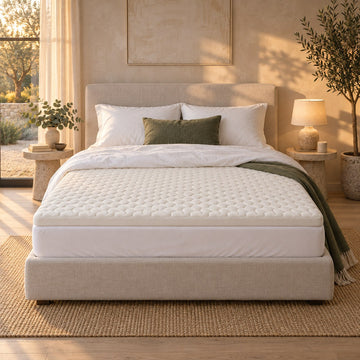
Record the finished mattress width, length and depth after delivery. A fitted sheet needs enough pocket depth to pass under the mattress without pulling the corners upward. A protector must fit without compressing the quilted surface. Flat sheets and duvets need enough drop for the sleeper and bed height.
Ask these questions in the original quotation:
- Is a matching protector available?
- Can fitted sheets be made to the finished depth?
- What shrinkage allowance does the fabric require?
- Is the custom bedding labelled with the final dimensions?
- Can replacement sets be reordered from a saved specification?
A saved specification is valuable. “Primary bedroom fitted sheet” is ambiguous in two years; “198 × 213 × 32 cm finished size, order reference…” is repeatable.
Send this for a useful quote
The fastest route to a reliable answer is a complete brief. Copy this checklist:
Custom mattress request
Bed location:
Inside width at head / centre / foot:
Inside length at left / centre / right:
Support-to-top target:
Corner or hardware obstructions:
Base type and slat spacing:
Narrowest delivery access:
Preferred Organic Collection model and feel:
Required protector / sheets:
Photographs attached: full frame, width, length, height, obstructions, access route.
Send the brief through the contact and quote page.
The most reassuring custom mattress is not the one described with the most luxurious adjectives. It is the one whose dimensions, construction, evidence and delivery path are agreed before any layer is cut.